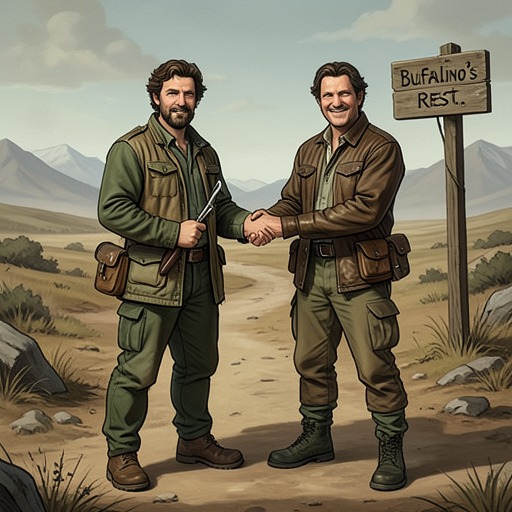
Frank Sheeran and Russell Bufalino: Mentor, Partner, and Close Friend
I Heard You Paint HousesFrank Sheeran and Russell Bufalino were partners in criminal work, but their relationship in the account is more than an alliance of convenience: Bufalino appears as Sheeran’s mentor and protector, while their shared history persists through prison, illness, and the unresolved consequences of Jimmy Hoffa’s disappearance. Its defining tension is the coexistence of practical loyalty and moral knowledge. They remained close, even as their association with violence and the silence surrounding it became harder to separate from their friendship.
A Partnership Built on Trust
Sheeran’s account presents Bufalino as an authority whose confidence mattered. In 1977, a Syracuse grand jury questioned Sheeran about whether Bufalino had ever had him shoot anyone. Later that week, investigators put the reverse question to Bufalino: whether Sheeran had been involved in killing anyone. Bufalino answered, “Not to my knowledge. To my knowledge the Irishman is a big pussycat.” The remark portrays Sheeran as harmless, but it also records how Bufalino spoke about him under official questioning: as a trusted associate whose violent capacity he declined to acknowledge.
The grand jury’s questions also touched their private world. Investigators asked Sheeran about a pad Jimmy Hoffa had at Lake Orion with “Russ & Frank” written on it, and about the Pad, a private club in Endicott, New York, for Bufalino’s family. Sheeran said he went there to play the Italian fingers game Amore, in which the participants decided who would be boss and underboss and who would drink the wine. The details place their names together not only in the context of alleged criminal work but within a circle of family, ritual, and rank. Sheeran was questioned for nine hours in Syracuse; his account emphasizes that he drew on lessons in how to testify that he had learned from Hoffa.
Shared Work and the Limits of What Is Known
The book connects Bufalino and Sheeran to a tightly bound trio that also included John Francis. In 1972, on Bufalino’s orders, Francis drove while Sheeran killed Joey Gallo. In 1978, again on Bufalino’s orders, Francis fired when Sheeran shot Salvatore Briguglio. These episodes establish the account’s portrayal of their network: Bufalino could direct, Sheeran could carry out killings, and Francis could take part in the operations. They also make the possibility of the trio’s involvement in Hoffa’s 1975 disappearance difficult to dismiss within the narrative.
That possibility is not presented as proof. The narrator explicitly allows that Francis might have had no role in the Hoffa killing, while observing that his commercial real-estate connections could have reached widely. After a Detroit reporter traced the history of the house where Sheeran claimed to have shot Hoffa, the former owner’s son described a mysterious single man renting a room there after his mother moved out and before she sold the property in 1978. The account asks whether that boarder might connect Francis to the house, but leaves the link unresolved. For the Sheeran–Bufalino relationship, this uncertainty matters: it places their established association with ordered violence beside an unconfirmed question about the crime that shaped their later lives.
Prison as a Continuation of the Bond
When Sheeran was imprisoned at the United States Penitentiary, Sandstone, his relationship with Bufalino continued within the constraints of federal custody. Sheeran says FBI agents summoned him in the middle of the night and offered to move him closer to his daughters if he cooperated. He refused and walked back to his block along a yellow rope in the severe cold. The episode does not directly describe a meeting with Bufalino, but it shows the pressure surrounding Sheeran in prison: authorities were still seeking information, while he maintained a refusal to become an informant.
Later, when Sheeran’s arthritis worsened, the warden sent him to the United States Medical Center for Federal Prisoners, Springfield. Bufalino was there in a wheelchair after a stroke, and Sheeran describes being back with his teacher. They played bocce; Bufalino could still hit well for his age, and occasionally gave Sheeran a small shot when Sheeran beat him at gin. Sheeran also obtained ice cream for Bufalino, who could use the commissary only once a week. The exchange reverses some of the relationship’s earlier practical roles: the mentor is physically diminished, and Sheeran takes care of a small daily pleasure, but the attachment and deference remain.
Their friendship also appears in an ordinary piece of family news. While Sheeran was at Springfield, his daughter Connie had her first baby. Bufalino heard the news from his wife, Carrie, and came out to the bocce court to tell Sheeran. The scene joins the men’s private companionship to the family lives that continued beyond prison walls. Their contact was not only about business or shared danger; it included games, food, and news that mattered because it came from one friend to another.
Loyalty, Silence, and Regret
In private conversations at Springfield, Sheeran says he and Bufalino spoke about Hoffa and that he learned additional details about what had happened. Neither man, he says, wanted events to go as far as they did. Both felt Hoffa did not deserve it, and Sheeran remembers Bufalino’s view that Hoffa was a nice man with a nice family. These remarks do not amount to a full explanation of the killing or a clear account of each man’s responsibility. Instead, they reveal a late moral recognition: their friendship with Hoffa and knowledge of his family remained present alongside the violence that ended in his disappearance.
The narrator describes Sheeran’s reluctance to expose Bufalino as an obstacle to confession. Sheeran did not want to hurt Bufalino’s widow, Carrie, or people who were still alive, and feared that speaking would make others think he had abandoned the code by which he had lived. He said, “I lived my life a certain way. I don’t want people thinking I went the other way.” He also warned that disclosing what he knew about Bufalino could alert others that he knew things about them. The fear was therefore not simply personal embarrassment: speaking about a close friend threatened the network of silence that had protected both men and their associates.
By the time of those conversations, the relationship had acquired a painful contradiction. Sheeran continued to treat Bufalino as his teacher and close friend, sought to care for him in the hospital, and carried the memory of their shared life into old age. At the same time, the story places that intimacy beside grand-jury denials, ordered killings, and the still-unsettled possibility of a connection to Hoffa’s murder. Their bond endured, but it could not resolve what their loyalty had helped conceal.